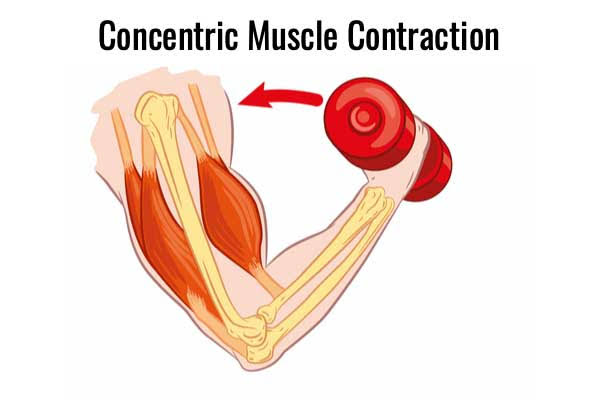
Muscles work by converting chemical energy (from ATP) into mechanical energy, allowing movement and maintaining posture. Each muscle is made up of tiny fibers that contract when stimulated by nerve impulses. The way these fibers contract determines the type of muscular action. Below are the main types of muscle contractions:
In this type, the muscle shortens as it produces force, and the points of insertion move closer together. This is the most common form of contraction used in lifting or pushing movements.
Example: Lying on the back and lifting a weight upward (such as a bench press).
Here, the muscle generates tension without changing its length. The joint angle and muscle length remain constant, but the muscle still exerts force.
Example: Holding the “Iron Cross†position on the rings in gymnastics — the arms stay extended, and the muscle maintains tension without movement.
The muscle lengthens while under tension, controlling the motion as it resists an external load. This type helps in stabilizing and controlling the descent of movements.
Example: Bending the knees slowly while carrying weight on the shoulders (such as during the downward phase of a squat).
This involves a quick combination of eccentric (lengthening) followed by concentric (shortening) contraction. The muscle first stretches and then contracts rapidly to produce powerful movements.
Example: Jump training or rebound push-ups where the muscle stretches before an explosive movement.
These different contraction types allow the human body to perform a wide range of movements — from static holds to explosive actions — essential in sports like gymnastics, athletics, and weightlifting.